
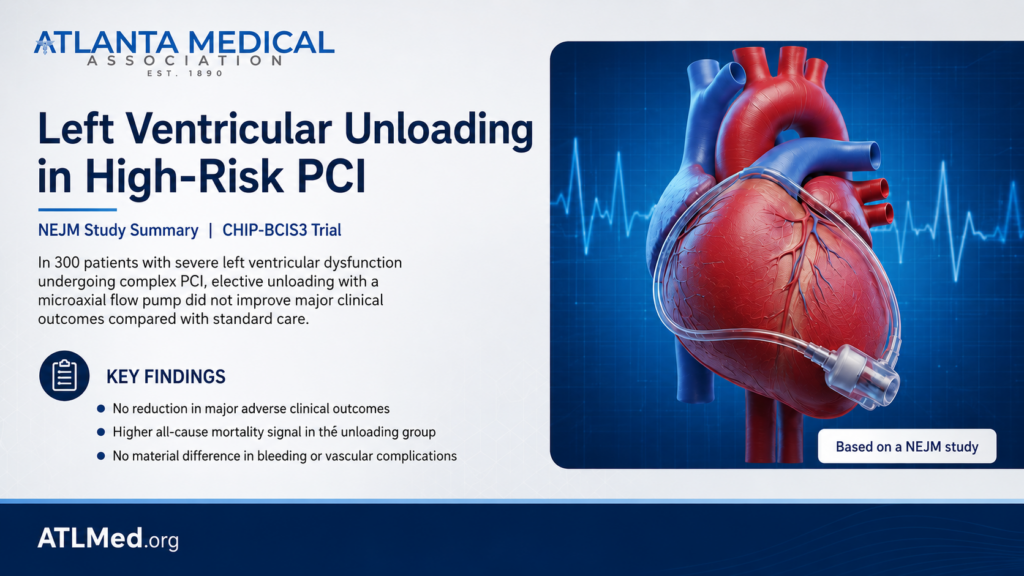
March 29, 2026 — A pivotal trial published in The New England Journal of Medicine challenges assumptions about left ventricular unloading strategies during high‑risk percutaneous coronary intervention (PCI).
Background:
Patients with severe left ventricular dysfunction (often defined by an ejection fraction ≤35%) who undergo complex PCI face a high risk of procedural complications, including death, myocardial injury, stroke, and cardiovascular hospitalization. Clinicians have increasingly used temporary mechanical circulatory support, such as microaxial flow pumps, to unload the left ventricle and theoretically protect the heart during revascularization.
However, robust randomized evidence for this strategy has been lacking—until now.
The CHIP‑BCIS3 Trial: Study Design and Population
The Controlled Trial of High‑Risk Coronary Intervention with Percutaneous Left Ventricular Unloading (CHIP‑BCIS3) was a prospective, multicenter, open‑label randomized trial involving 300 patients across 21 sites in the United Kingdom. Participants all had extensive coronary artery disease and severely reduced left ventricular function and were scheduled for complex PCI.
Patients were assigned either to:
- Elective LV unloading: insertion of a microaxial flow pump (e.g., Impella CP) before PCI, or
- Standard care: PCI without planned mechanical support (no intra‑aortic balloon pump or ECMO, except for emergency bailout).
The primary endpoint was a hierarchical composite of major adverse clinical outcomes (all‑cause death, disabling stroke, spontaneous myocardial infarction, cardiovascular hospitalization, or periprocedural myocardial injury) over at least 12 months of follow‑up.
Key Results
- No improvement in the primary outcome: The use of LV unloading with a microaxial flow pump did not significantly reduce the risk of major adverse clinical outcomes compared with standard PCI alone.
- Mortality signal: In some analyses, patients in the LV unloading group had a higher rate of cardiovascular death, suggesting possible harm rather than benefit in this high‑risk cohort.
- Similar procedural safety: There were no significant differences in bleeding or major vascular complications between the groups.
Clinical Implications
This landmark trial casts doubt on the routine use of elective LV unloading during high‑risk PCI. While the theoretical rationale for unloading is compelling—reducing workload on a weakened ventricle and potentially limiting ischemic injury—the actual clinical impact appears limited or even unfavorable based on this randomized evidence.
These findings emphasize several important points for practicing clinicians:
- Evidence over intuition: Strategies that seem mechanistically beneficial must still be validated in rigorous trials before widespread adoption.
- Selective use of support devices: Mechanical circulatory support may still be appropriate in specific scenarios (e.g., cardiogenic shock), but its routine elective use as adjunct to PCI in severe LV dysfunction is not supported by CHIP‑BCIS3 results.
- Future research directions: Additional studies are needed to identify subgroups that might benefit, or to refine device technology and procedural protocols.
Conclusion
The CHIP‑BCIS3 findings, as reported in The New England Journal of Medicine, provide high‑quality evidence that elective left ventricular unloading with microaxial flow pumps does not improve outcomes in patients with severe LV dysfunction undergoing complex PCI and may be associated with increased cardiovascular mortality. These results should inform clinical decision‑making, guideline development, and future research in interventional cardiology.
