
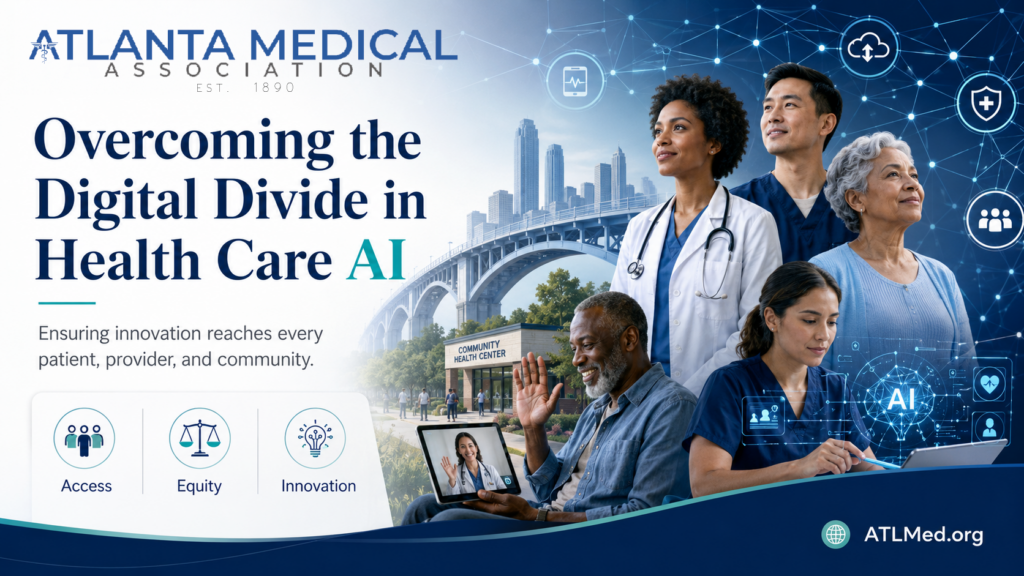
Ensuring Innovation Reaches Every Patient, Provider, and Community
Artificial intelligence is rapidly becoming one of the most important forces shaping the future of health care. From helping clinicians review medical images and summarize patient notes to supporting population health analysis, clinical research, remote monitoring, and patient navigation, AI has the potential to improve access, efficiency, and outcomes.
But there is a critical question facing health care leaders: Will AI help close health disparities, or will it widen them?
For communities that already face barriers to care — including rural residents, low-income families, older adults, patients with limited English proficiency, and historically underserved populations — the rise of AI could create new opportunities. It could also deepen existing gaps if the technology is designed, deployed, and governed without equity at the center. Experts are increasingly warning that an “AI digital divide” is emerging between well-resourced health systems and safety-net providers such as community health centers that serve rural and underserved communities.
For ATLMed.org and the broader Atlanta medical community, this conversation is especially timely. As AI tools become more common in clinical care, medical education, research, and patient engagement, health care organizations must ensure that innovation does not leave vulnerable communities behind.
What Is the Digital Divide in Health Care AI?
The digital divide in health care refers to unequal access to the tools, infrastructure, literacy, and support needed to benefit from digital health services. In the AI era, this divide includes more than internet access. It includes access to broadband, connected devices, patient portals, telehealth platforms, culturally responsive digital tools, trustworthy data systems, and clinicians trained to use AI responsibly.
The Digital Health Equity Framework describes digital health equity as more than simply giving people access to technology. It includes equitable access, equitable outcomes, equitable patient experience, and equity in the design of digital health tools.
This matters because AI systems rely on data. If the data used to build these tools does not adequately represent diverse populations, the resulting technology may perform better for some patients than others. If AI tools are only available in well-funded hospitals or large academic systems, patients served by smaller practices, community clinics, and rural providers may be excluded from the benefits.
In other words, the AI divide is not just a technology issue. It is a health equity issue.
Why the Divide Matters
Health care AI promises faster decision-making, more personalized care, improved administrative efficiency, and better use of clinical data. But the same tools that improve care in one setting can reinforce inequity in another.
For example, patients who lack reliable broadband may not be able to use AI-supported telehealth platforms. Providers in safety-net settings may not have the financial resources to adopt advanced digital tools. Smaller practices may lack technical staff to evaluate AI vendors, integrate software into electronic health records, or monitor algorithmic performance. Patients with limited digital literacy may struggle to navigate automated chatbots, online intake forms, or app-based care pathways.
Research and policy discussions continue to emphasize that digital health tools must be intentionally designed with equity throughout the full lifecycle — from planning and implementation to evaluation and improvement. The Digital Health Care Equity Framework, developed with support from the Agency for Healthcare Research and Quality, was created to help organizations integrate equity into digital health solutions from the beginning rather than treating it as an afterthought.
Without this intentional approach, AI could make health care more efficient for those already well served while making access more complicated for those who need support the most.
The Rural and Urban Access Challenge
The digital divide is especially visible in rural communities and health care deserts. Telehealth has often been described as a way to expand access to care, but its success depends on broadband connectivity, device access, patient comfort with technology, and availability of clinicians. The Federal Reserve Bank of Atlanta has noted that without addressing the digital divide in communities with the highest need, telehealth’s ability to close health care gaps will remain limited.
This lesson applies directly to AI. Remote monitoring, virtual care assistants, automated scheduling, AI-powered patient education, and digital triage tools all depend on the same underlying infrastructure. If patients cannot connect, log in, understand, trust, or afford the technology, the promise of AI-enabled care becomes out of reach.
Urban communities face their own digital divide. In many cities, broadband may technically be available, but affordability, device access, language barriers, disability access, and digital literacy still shape who can benefit from technology-enabled health care.
AI Bias and Representation in Health Data
One of the most important equity concerns in health care AI is bias in the data used to develop and train algorithms. AI systems learn from historical information. If that information reflects unequal access, underdiagnosis, undertreatment, racial bias, or gaps in clinical documentation, the AI system may reproduce those inequities.
In cancer care, for example, researchers have noted that AI has significant potential to improve diagnosis and personalize treatment, but concerns remain about performance across diverse populations because of biased training data and limited access to AI technologies in low-income and rural settings.
The same concern applies across cardiology, maternal health, primary care, behavioral health, chronic disease management, and emergency care. A tool that works well in one population may not work equally well in another unless it is tested, validated, and monitored across different racial, ethnic, geographic, socioeconomic, age, language, and disability groups.
Health care organizations must ask difficult questions before adopting AI:
Does this tool work for the patients we serve?
Was it tested on diverse populations?
Can clinicians understand how it supports decisions?
How will we monitor for errors or unequal outcomes?
What happens when the AI recommendation conflicts with clinical judgment?
How are patient privacy, consent, and trust protected?
These questions should be part of every AI implementation strategy.
The Role of Safety-Net Providers and Community Health Centers
Community health centers, independent practices, and safety-net providers are essential to advancing AI equity. These organizations often serve the very communities that stand to benefit most from improved access, earlier diagnosis, better care coordination, and reduced administrative burden.
However, many safety-net providers lack the same capital, staffing, analytics infrastructure, and vendor support available to large health systems. That is why experts have warned that an AI digital divide is emerging between well-resourced health systems and community health centers.
Closing this gap requires investment. AI equity cannot depend solely on whether an organization has the budget to purchase the newest technology. Public agencies, health systems, medical associations, foundations, universities, and private-sector partners should work together to ensure that AI tools are accessible, affordable, interoperable, and designed for real-world community care settings.
Trust Is Infrastructure, Too
Technology alone cannot close the digital divide. Trust is just as important as broadband, software, or devices.
Many communities have experienced medical discrimination, research exploitation, lack of representation, and poor access to culturally responsive care. If AI is introduced without transparency and community engagement, patients may see it as another barrier rather than a benefit.
Building trust means explaining how AI is used, what data it relies on, when a human clinician remains involved, and how patients can ask questions or opt out when appropriate. It also means making sure AI tools do not replace relationships in care. For many patients, especially those managing chronic conditions, trust grows through consistent communication, respect, and shared decision-making.
AI should support the patient-clinician relationship, not weaken it.
Practical Strategies for Overcoming the AI Digital Divide
Health care organizations can take several practical steps to ensure AI adoption is equitable and responsible.
1. Start With the Community, Not the Technology
Before selecting an AI tool, health care leaders should identify the needs of the community. Are patients struggling with appointment access, medication adherence, transportation, chronic disease follow-up, language access, or specialist referrals? The best AI use cases should solve real problems identified by patients, caregivers, and providers.
2. Invest in Digital Access
Broadband, devices, patient portal access, and technical support remain foundational. McKinsey has noted that affordable broadband combined with wraparound support can expand access to cost-efficient virtual health for underserved communities.
3. Require Equity Testing Before Deployment
AI tools should be evaluated for performance across different demographic and clinical populations. Vendors should be able to explain what data was used, how the model was validated, and what safeguards exist to prevent biased outcomes.
4. Keep Clinicians in the Loop
AI should assist clinical decision-making, not replace professional judgment. Physicians, nurses, care coordinators, and other health professionals need training on when to trust, question, or override AI-generated recommendations.
5. Build Digital Health Literacy
Patients need clear, accessible education about how digital tools work. This includes plain-language instructions, multilingual support, disability-accessible design, and in-person assistance for those who need it.
6. Monitor Outcomes Over Time
Equity is not achieved at launch. Organizations should track whether AI tools improve outcomes for all groups or only for some. Telehealth equity dashboards have been proposed as one way to promote transparency, continuous improvement, and equity-centered implementation.
7. Support Smaller and Community-Based Providers
Medical associations, academic institutions, health systems, and public agencies can help independent and safety-net providers evaluate AI tools, train staff, apply for funding, and implement responsible digital health strategies.
Responsible AI Governance Is Essential
National and global health leaders are increasingly calling for AI governance that protects patients and promotes equity. The National Academy of Medicine has emphasized collaboration across disciplines to ensure emerging technologies such as AI, genomics, and telemedicine are developed and applied responsibly and effectively.
The National Academies have also warned that emerging science and technology in health and medicine must be aligned with equity through governance frameworks that guide responsible innovation.
For health care organizations, governance should include clinicians, data experts, compliance leaders, ethicists, patients, community representatives, and operational staff. The goal is not to slow innovation, but to make sure innovation is safe, effective, transparent, and fair.
What This Means for Atlanta’s Health Care Community
Atlanta is home to major health systems, academic institutions, public health organizations, community clinics, medical associations, technology companies, and historically significant institutions committed to health equity. This gives the region an opportunity to become a leader in responsible, inclusive health care AI.
ATLMed.org can help advance this conversation by supporting education, convening stakeholders, highlighting evidence-based tools, and encouraging physicians and health leaders to ask equity-centered questions before implementing AI.
The future of health care AI should not be defined only by what technology can do. It should be defined by who benefits.
Conclusion: Innovation Must Be Inclusive
AI has the potential to transform health care, but its success will depend on whether it reaches the patients and providers who need it most. Overcoming the digital divide in health care AI requires more than new software. It requires investment in infrastructure, digital literacy, community trust, diverse data, responsible governance, and a commitment to equity.
If health care leaders act intentionally, AI can help expand access, reduce administrative burden, improve clinical insight, and support better outcomes. But if equity is ignored, AI could deepen the same disparities medicine has worked for generations to overcome.
The challenge — and the opportunity — is clear: health care AI must be built for everyone.
