
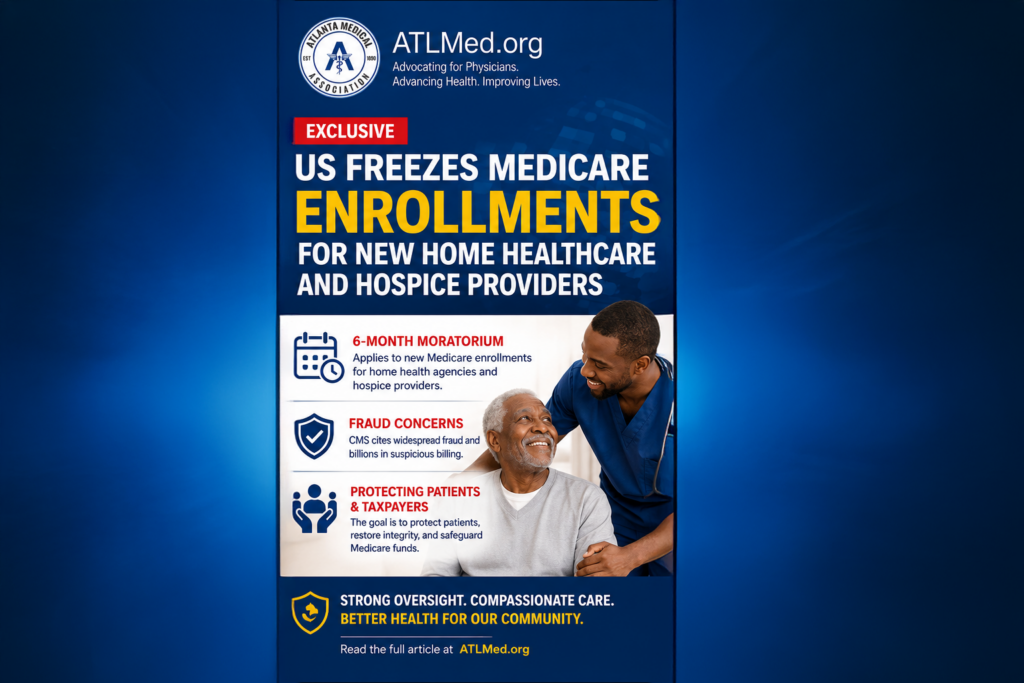
The Centers for Medicare & Medicaid Services has announced a six-month nationwide moratorium on new Medicare enrollments for home health agencies and hospice providers, citing concerns about fraud, waste, and abuse in two sectors that serve some of the nation’s most vulnerable patients. The action, announced May 13, 2026, applies to new Medicare enrollment applications and certain changes in majority ownership for home health and hospice providers. Existing Medicare-enrolled providers are expected to continue operating and serving patients during the pause.
For patients, families, physicians, and health care organizations, the announcement raises an important question: How can the government protect Medicare beneficiaries and taxpayer dollars without limiting access to essential home-based and end-of-life care?
Why CMS Is Taking Action
CMS says the freeze is part of a broader federal effort to combat fraudulent billing and protect Medicare beneficiaries. According to CMS, recent enforcement actions included payment suspensions involving approximately 800 hospices and home health agencies in Los Angeles suspected of fraud, tied to $1.4 billion in Medicare spending last year, with $70 million in suspended funds so far.
Federal officials have long identified home health and hospice as areas vulnerable to fraud. In some schemes, bad actors may bill Medicare for services that were never provided, enroll patients in hospice who are not eligible, use misleading marketing tactics, or bill for care that patients did not need or did not knowingly request. Reuters reported that the Senior Medicare Patrol, a national fraud-prevention network, has repeatedly warned older adults about hospice and home health fraud risks.
CMS Administrator Dr. Mehmet Oz said the action is intended to protect patients, restore integrity, and safeguard taxpayer dollars.
What the Moratorium Does — and Does Not — Do
The six-month moratorium temporarily blocks new home health agencies and hospice providers from enrolling in Medicare. It also applies to certain ownership changes that CMS says can be used to disguise control by fraudulent operators.
The freeze does not remove existing providers from Medicare solely because of the moratorium, and CMS has said current Medicare-enrolled hospice and home health providers may continue serving beneficiaries. During the pause, CMS says it will expand targeted investigations, use advanced data analytics, and accelerate removal of providers suspected of fraudulent activity.
The moratorium may be extended in additional six-month increments if CMS determines that continued action is necessary.
Why This Matters for Patients and Families
Home health and hospice services play a critical role in the health care system. Home health can help patients recover after hospitalization, manage chronic illness, receive skilled nursing care, and avoid unnecessary institutional care. Hospice provides comfort-focused care for patients with serious illness near the end of life, while also supporting families and caregivers.
In 2024, 1.8 million Medicare beneficiaries received hospice care at a cost of $28.3 billion, while 2.7 million Medicare beneficiaries received home health care at a cost of $16 billion, according to figures cited by Reuters from federal advisory and agency sources.
Because these services are so personal and often delivered in the home, fraud can cause more than financial harm. It can confuse families, disrupt care planning, exploit seniors, and undermine trust in legitimate providers.
Access Concerns for Communities
While many stakeholders support stronger oversight, some provider groups have warned that a broad nationwide freeze could affect access, especially in rural and underserved areas where care options may already be limited. The National Alliance for Care at Home warned that enrollment moratoria do not always distinguish between fraudulent operators and compliant providers, and said overly broad freezes could reduce competition, slow innovation, and raise access-to-care concerns.
This is an important concern for the Atlanta medical community and communities across Georgia. Patients discharged from hospitals often need timely home health referrals. Families facing end-of-life decisions may need hospice support quickly. If legitimate new providers are unable to enter the Medicare program during the moratorium, some areas could experience fewer options or delays in care — particularly where provider networks are already thin.
The Balance: Fraud Prevention and Patient Access
The challenge for policymakers is to strike the right balance. Fraud prevention is essential. Medicare dollars should support legitimate care, not deceptive billing schemes. At the same time, enforcement strategies must be carefully designed so they do not unintentionally restrict access to high-quality care.
CMS has described the moratorium as “data-driven,” and industry groups have urged the agency to use risk-based enforcement, stronger provider screening, targeted audits, and on-the-ground surveys to identify fraudulent operators without broadly penalizing high-performing providers.
For clinicians and health care organizations, the key issue is not whether fraud should be addressed. It should. The key issue is how to ensure that enforcement protects patients while preserving appropriate access to home-based and hospice care.
What Physicians and Care Teams Should Watch
Physicians, discharge planners, care coordinators, and social workers should monitor how the moratorium affects referral networks over the next six months. Existing Medicare-certified providers should continue operating, but new entrants may be delayed, and some ownership-change transactions may be affected.
Care teams should also be alert to signs of potential fraud or patient confusion. Warning signs may include patients being enrolled in hospice without understanding what hospice means, unsolicited calls or visits from agencies offering “free” services, pressure to sign paperwork quickly, or billing notices for services the patient did not receive.
Patients and families should be encouraged to ask questions before accepting home health or hospice services. They should know the name of the agency, why the service is being recommended, which physician ordered it, what Medicare will be billed for, and how to report concerns.
Practical Guidance for Patients and Families
ATLMed.org readers can take several steps to protect themselves and loved ones:
First, confirm that any home health or hospice provider is properly Medicare-certified and connected to a legitimate care plan. Patients should not sign forms they do not understand.
Second, ask whether the service was ordered by the patient’s physician or care team. Legitimate home health services generally require a clinical need and physician involvement.
Third, review Medicare Summary Notices for unfamiliar services or providers. Unexpected hospice or home health claims should be questioned immediately.
Fourth, report suspicious activity. Patients can contact Medicare directly or connect with Senior Medicare Patrol resources for help identifying and reporting possible fraud.
What This Means for ATLMed.org Readers
The CMS moratorium is a significant national policy development with local implications. Atlanta physicians, hospitals, post-acute providers, hospice organizations, and patient advocates should follow the issue closely because home health and hospice are essential parts of the care continuum.
For legitimate providers, this moment also underscores the importance of compliance, transparency, documentation, and patient-centered communication. Strong clinical standards and ethical billing practices are not just regulatory requirements; they are essential to maintaining public trust.
Conclusion
The federal government’s six-month freeze on new Medicare enrollments for home health and hospice providers reflects growing concern about fraud in two high-need areas of care. The action is intended to protect patients and taxpayer dollars, but it also raises important questions about access, provider capacity, and the impact on communities that depend on timely home-based services.
For ATLMed.org readers, the takeaway is clear: fraud prevention and patient access must move forward together. Strong oversight is necessary, but so is a commitment to ensuring that seniors, people with disabilities, seriously ill patients, and families continue to receive high-quality, compassionate care when and where they need it most.
